Mitigation Bill Review has a PDF to ESX Conversion Problem
User Cases
Jan 19, 2026
Zach Gardner, CEO @ ClaimsFlow
Mitigation Review Today Is Bogged down by PDF Conversions
Mitigation reviewers receive stacks of PDF invoices from vendors.
Each invoice is structured differently, written differently, and uses a different Xactimate report type. Turning those invoices into Xactimate project isn't simple data entry; it requires interpretation, specialized knowledge, and line item mapping:
A single invoice may require:
Matching descriptions to the correct Xactimate code.
Determining the appropriate trade (e.g. WTR, HMR, TCR).
Making judgement calls on ambiguous line items (e.g. dehumidifier sizing)
Ex. What size dehu is this?

Multiply that effort across hundreds or thousands of invoices, and PDF conversion becomes a workflow bottleneck.
Reviewers, meanwhile, work under tight SLAs. Carriers demand fast and accurate reviews. Contractors want to get paid. Policyholders are waiting for closure.
Manual PDF conversion slows everything down. It limits throughput, increases costs, and forces experienced reviewers to spend their time on transcription instead of review.
For growing mitigation review teams, manual PDF conversion isn’t a simply inefficient. It’s unsustainable.
Why Faster, More Accurate PDF-to-ESX Conversion Matters

Fast, accurate PDF-to-ESX conversion directly determines how many files a mitigation review team can handle. When conversion is slow, everything downstream suffers:
Throughput is capped: Manual PDF conversion limits how many invoices a reviewer can process in a day. As volume increases, teams are bogged down with backlogs.
Higher costs: PDF transcription is expensive, labor-intensive work that consumes experienced reviewers’ time. This manual process makes it difficult to scale profitably without adding headcount.
Worse customer experience: Manual PDF conversion slows cycle times and makes it harder to meet tight SLAs.
With fast, accurate PDF-to-ESX conversion, teams can review more invoices per day without burning out senior staff. Costs come down. Cycle times shrink. And reviewers spend more time applying expertise, rather than re-keying data from PDFs.
Why PDF-to-ESX Conversion Breaks Down at Scale
Converting a PDF to and Xactimate project is more than a trivial administrative task. Every invoice requires specialized knowledge, judgement, and energy.
A few specific challenges.
Ambiguous line items
Is this line item WTR or HMR (Mold) or TCR?
Many mitigation services – such as Negative air fan/Air scrubber (24 hr period) - No monit. – overlap across multiple trades.
Assigning each line item to the appropriate trade requires investigations and judgment calls that slow conversion.
Custom invoice descriptions

Contents line items
Contents-related line items often rely on less common Xactimate codes. Even experienced reviewers may need to search, confirm, and validate these mappings.

High volume + manual judgment
During peak periods, especially CAT events, file volume spikes while turnaround expectations tighten. Backlogs grow faster than teams can process them.
ClaimsFlow Converts PDFs to ESX in Minutes
ClaimsFlow allows mitigation reviewers to seamlessly convert PDF invoices into Xactimate projects in minutes, eliminating the manual transcription process that slows teams down.
ClaimsFlow is a very helpful tool in the estimate writing process. It's increased my efficiency tremendously.
— Eric H, Mitigation Reviewer
Here’s how it works:
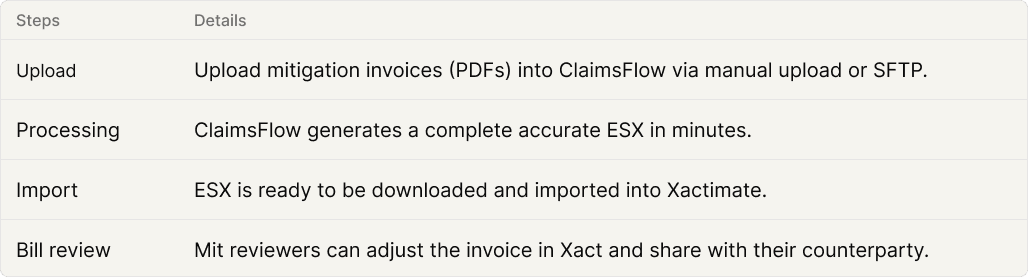
By eliminating manual busywork, ClaimsFlow helps teams increase throughput, maintain accuracy, and absorb higher volumes without adding headcount or burning out experienced reviewers.
See ClaimsFlow in Your Mitigation Workflow
Manual PDF conversion doesn’t have to slow your mitigation review operation.
See how ClaimsFlow fits into your workflow.

