Why the Insurance Claims Cycle Has a Flow Problem
Company
Dec 15, 2025
Zach Gardner, CEO @ClaimsFlow
The Ideal Claims Cycle is a Continuous Flow
Let’s imagine the perfect claims process.
It might look like cars driving on the highway. One car smoothly following another in a continuous flow. No stops; no slowdowns; no unnecessary turns or steps. That is, a new claim enters the system and then moves efficiently and continuously towards settlement.
Of course, that’s not how the claims process operates today.
The claims cycle today looks more like bumper to bumper traffic. There are starts and stops, traffic jams, breakdowns, and roadblocks.
At ClaimsFlow, our goal is to address the inefficiencies in the claims cycle so that the process looks less like bumper to bumper traffic and more like cars flowing down the highway.
In doing so, we can improve productivity, lower costs, and produce better outcomes for policyholders.
The Hidden Time Tax
Inefficiencies in the claims process matter because they compound. Slowdowns and delays ripple down the chain, adding buffers and extending settlement times.
Time has silently become the most important cost in the cycle. Today's claims process applies a system-wide “Time Tax” that everyone must pay – policyholders pay in the form of slower repairs; contractors pay through longer cashflow cycles; insurers pay through higher claims processing costs and worse customer service.
How a Bottleneck Stalls a Claim
To see how easily the cycle can stall, consider the workflow of James, a large-loss estimator:
James visits the property to inspect and document the loss.
Back at the office, James reviews the initial estimate from the adjuster. He sees that she missed a couple important areas.
To add the missing scope, James must convert the adjuster’s PDF estimate to his Xactimate. However, with field responsibilities and other projects in flight, James simply doesn’t have the time during his busy workday.
This is where the claim stops moving. The estimate sits on his desk until he’s able to carve out a couple hours over the course of three nights.
Three days later – after he has rewritten and supplemented the fire loss – James sends the estimate back to the adjuster for her review.
For three days, the claim sits at a standstill on James’ desk, stuck in bumper to bumper traffic. What should be a quick edit ends up being a five-day process.
James’ situation is not unique. In fact, in a complex, multi-party claims cycle, there are many similar stops and slowdowns before and after this step. Over the course of a claim, these small stalls compound to further lengthen settlement timelines.
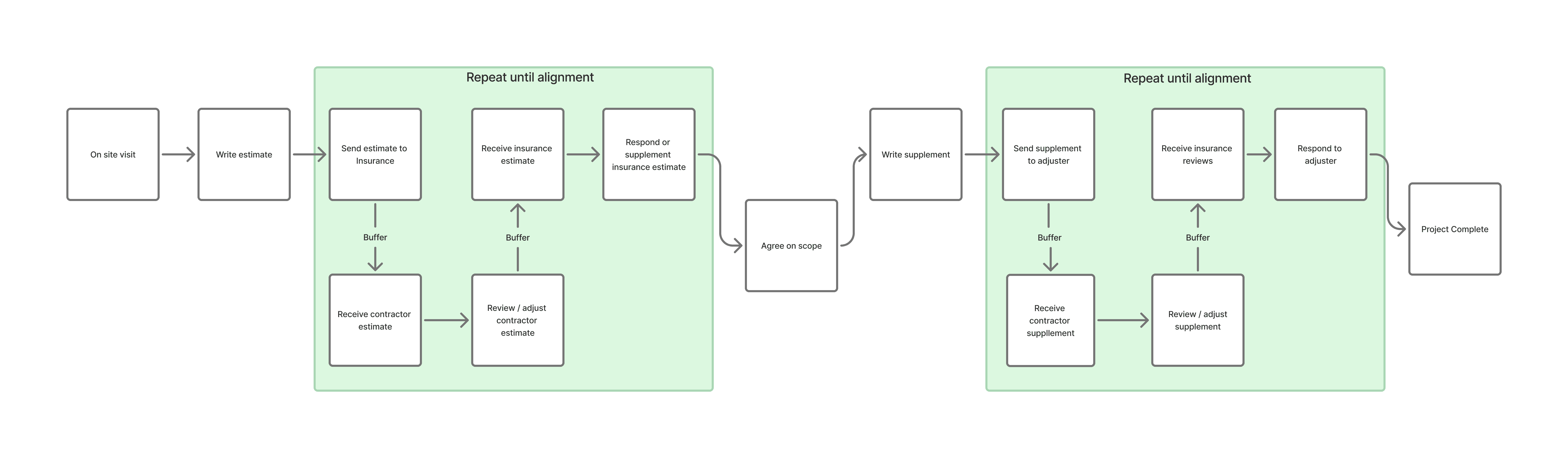
These delays aren’t happenstance. They are a result of how the system is organized and operated today.
The Three Systemic Causes of Claims Bottlenecks
The challenges in the claims cycle are structural. Delays are not due to a lack of effort or intent; they are the predictable result of an inefficient system. As a result, capable, well-intentioned folks across the industry must compensate by working long hours — such as nights and weekends — to keep claims moving through a system that was not designed for continuous flow.
Across the claims cycle, most bottlenecks can be traced to three root causes:
Unnecessary steps – Areas of the cycle that add time, but not value. Rewriting a PDF into Xactimate (PDF to ESX), for example, is an unnecessary, wasteful step due to system inoperability. The cycle can be simplified without it.
Slow production rates – Steps in the cycle where the work is inherently slow and manual, creating a slowdown in the claims process. This includes manual estimate review and comparison work.
Buffers – Waiting time between steps due to batched workloads. Because of competing priorities (e.g. work in the field, other claims to process etc.), folks can often only complete work during certain windows. As a result, many estimates sit, waiting for their window. Often, the buffer between tasks exceeds the actual work time itself.
The longest delays occur when more than one of these forces is present at the same time.
PDF to ESX: When Unnecessary Steps Create Long Buffers
Seen through the lens above, James’ work converting the adjuster’s PDF to ESX illustrates two of the three root causes simultaneously.
PDF to ESX is an unnecessary step – James has to spend hours transferring estimate information from a PDF to Xactimate. There is no value or new information created. The system forces humans to manually bridge gaps in system interoperability.
PDF to ESX creates a long buffer – With other obligations in the field, James only has limited windows each evening to convert the PDF to ESX. Outside of those windows, the estimate sits waiting on his desk. This means that the buffer time (3 days) dwarfs the time spent actually converting the estimate (~4 hours).
When unnecessary steps introduce buffers, progress slows – even when everyone is doing their part.
PDF conversion is only one example. Elsewhere in the claims cycle, work slows for different reasons. In future posts, we’ll explore those areas and show how reducing friction helps claims move the way they should.
**
Other Articles:

